ISSEY MIYAKE
"Even when I work with computers, with high technology, I always try to put in the touch of the hand." -Issey Miyake
Miyake’s fearless approach to design is a liberation of ideas, unconstrained by any pre-existing rules or framework. He works in a manner that not only advances his own ideas but also cultivates skills in the people around him, constantly pushing both the tradition and the evolution of design.
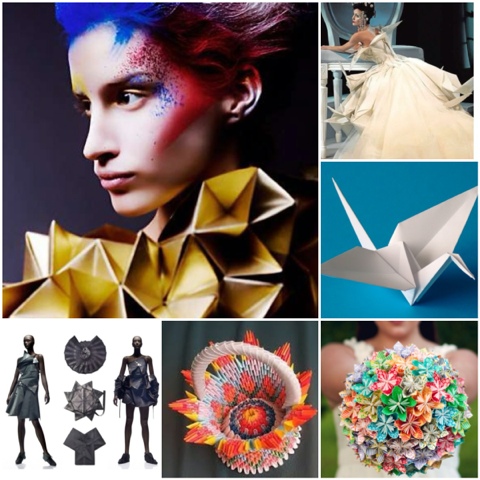
Born on April 22, 1938 in Hiroshima, Japan, he witnessed and survived the atomic bomb dropped on Hiroshima. The darkness of experiencing war as a child, is evident in his work and the lasting impact on his choice of colors and themes. He often plays with shapes, and origami like creations.
Miyake, later graduated from Tama Art University in Tokyo. He then started to work in Paris and New York. Returning to Tokyo in 1970, he founded the Miyake Design Studio.
YOHJI YAMAMOTO

"I think perfection is ugly. Somewhere in the things humans make, I want to see scars, failure, disorder, distortion."
"With my eyes turned to the past, I walk backwards into the future."
-Yohji Yamamoto
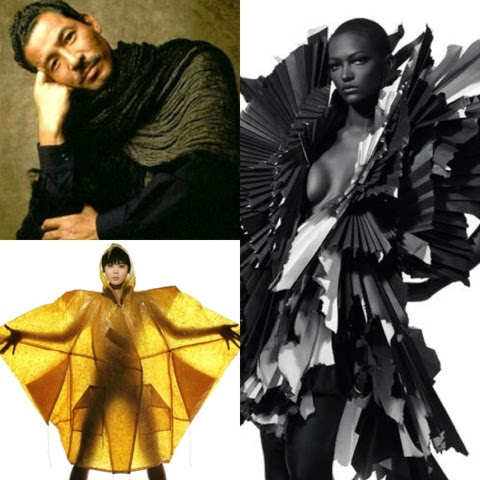
Yohji Yamamoto has had a long career of smashing fashion boundaries by pursuing anti-fashion through fashion. From his first Tokyo collection in 1977, “avant-garde’s Far Eastern couturier", his creation are always testing the boundaries of stereotypes of what beauty is. His style, is asymmetrical, unpredictable, and a celebration of "ugly" beauty.
Yamamoto first descended on the Paris scene in 1981 with what the Tokyo press had dubbed the “crow look”. His designs included voluminous black garments cut along severe, almost monastic lines. Enveloped in elegant asymmetry, Yamamoto’s crop-haired, makeup-less models somberly filed out in simple flats.
Born in Tokyo, Yamamoto graduated from Keio University with a degree in law in 1966. His further studies were in fashion design at Bunka Fashion College led to a degree in 1969.
KENZO TAKADA

“My work was always about freedom and harmony. I’d like to be remembered as a designer who crossed boundaries." -Kenzo Takada
Kenzo Takada, from provincial city of Himeji, Japan, decided to embark upon a grand adventure. Never having left Japan before, he bought a one-way, second-class passage to Europe. The six-week sojourn, took him to Hong Kong, Vietnam, Singapore, Sri Lanka, Djibouti, Egypt, and finally France.
The dazzling kaleidoscope of sights and sensations he encountered would change the course of his life. The array of native customs and costume would have a lasting impact on his psyche and inspired his desire to "create".
5 years later, he opened a boutique in Paris selling his own designs. The shop was located on Galerie Vivienne, far from the rarefied bastions of the haute couture, and its clothes capturing the joyful spirit of a multicultural world.
He borrowed ethnic gestures from all over the world, African boubous, Vietnamese ao dai tunics, Nehru jackets, and Austrian dirndls. He would combine these ideas and created head-turning creations.
HANAE MORI

“I feel sad to think that human hands are atrophying as so many things are made by computer. I make clothes for people who will cherish them.” -Hanae Mori
Hanae Mori is the only Japanese woman to have presented her collections on the runways of Paris and New York. She is also the first Asian woman to be admitted as an official haute couture design house by the federation francaise de la couture in France. She is also the most honored female designer in Japan. Being one of the first women to have a career in fashion in Japan, she is widely regarded as an icon of liberated women.[
After graduating from Tokyo Womens Christian University, Hanae Mori married and attended dress-making school. She opened her first atelier in 1951 and over the next several years designed costumes for hundreds of movies. In 1965, she successfully presented her first New York collection, "East Meets West". Twelve years later, she opened an haute couture showroom in Paris.
Her signature symbol is the butterfly.
JUNYA WATANABE
"I am not interested in the mainstream."
-Junya Watanabe
Junya Watanabe began his fashion career as pattern cutter at Comme des Garçons, straight out of Tokyo’s Bunka Fashion College.
Watanabe's creations are not ever targeted to a specific woman, or inspired by a singular theme, but instead is driven by a feeling.
“I always start from zero each season,” “to create an interesting form. . . . [It’s] more a question of feeling.” -Junya Watanabe
Watanabe’s real concern with each collection is to ask and answer a question. His fashion does not reek with nostalgia and yet maintains true to the past. Always growing with the times, his designs are technologically graphic, and innovative.